Here's the short answer. Dual-eligibility, low income, or a disability can open the door to extra help. Five government programs — Medicare, Medicaid, Medicare Advantage, the Marketplace, and CHIP — cover most people, and how each pays, runs, and delivers care differs.
Three Questions to Understand Any Program
To learn about any health insurance program, ask these three things:
- Who pays for it? Is it federal money, state money, or both? Does it come from taxes or from premiums people pay?
- Who runs it? Does the federal government run it directly? Do states manage it under federal rules? Do private companies manage it for the government?
- Who delivers the benefits? Does the government provide the care directly, or do private insurance companies and doctors do it?
These questions explain the differences between Medicare, Medicaid, Medicare Advantage, the Marketplace, and CHIP.
Medicare
Medicare is a federal health insurance program run by the Centers for Medicare and Medicaid Services (CMS).
Who is eligible? Mostly people age 65 and older. It also covers some younger people with disabilities or end-stage renal disease (ESRD), which means permanent kidney failure.
Who pays for it? Payroll taxes (from your working years), monthly premiums, and general taxes fund Medicare.
Who enrolls? Most people do not have to apply. If you worked and paid Medicare taxes, you are automatically eligible at age 65.
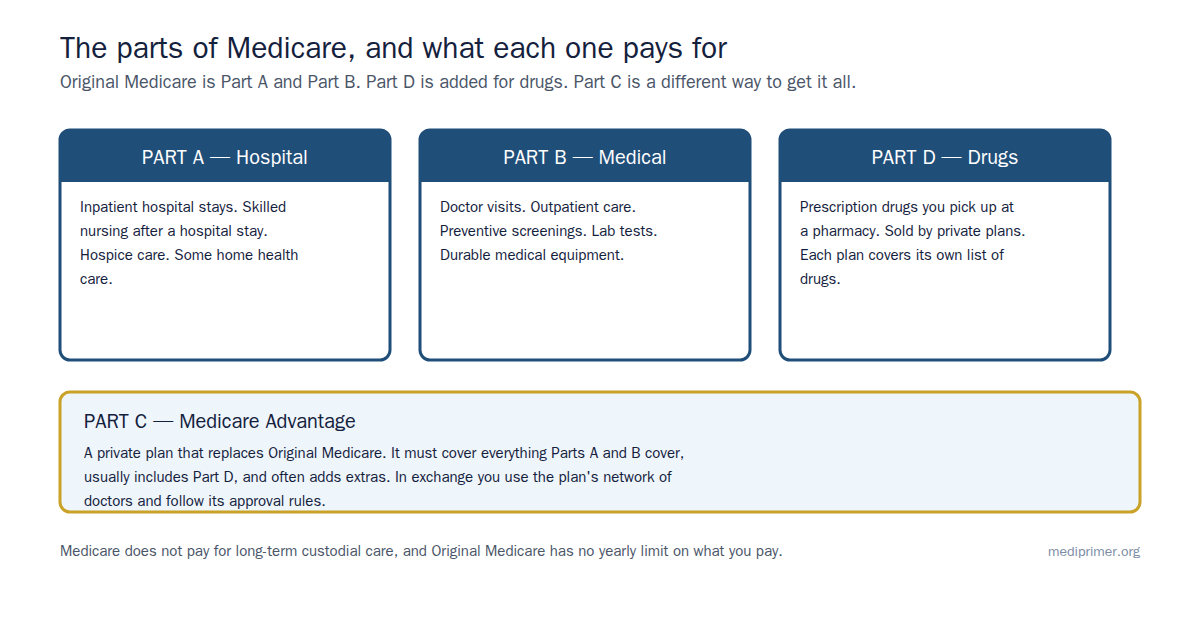
Medicare has four parts:
- Part A (Hospital Insurance) covers hospital stays, nursing care, hospice, and home health services.
- Part B (Medical Insurance) covers doctor visits, outpatient care, medical equipment, and other services.
- Part C (Medicare Advantage) is an alternative private plan that combines all Medicare benefits. (See details below.)
- Part D (Prescription Drug Coverage) covers prescription medications.
Most people choose Original Medicare (Parts A and B). The government directly runs this plan through a network of doctors and hospitals.
Other people choose Medicare Advantage (Part C), which is a single private plan that combines all the benefits.
Learn more at Medicare.gov.
Medicaid
Medicaid is a program run jointly by the federal government and each state. It provides health coverage to low-income people and families.
Unlike Medicare (which is entirely federal), each state runs Medicaid under federal rules. This means the rules are different in each state. Eligibility, covered services, and how you enroll vary by state.
Who pays for it? The federal government and state governments split the cost using a formula called the Federal Medical Assistance Percentage (FMAP).
Who is eligible? Traditionally, pregnant women, children, parents, older adults, and people with disabilities could get Medicaid. But income limits and specific rules vary by state. Some states expanded Medicaid after the Affordable Care Act. Others did not.
How do you get care? In most states, private insurance companies (called managed care organizations or MCOs) contract with the state to provide benefits. In some states, the state pays doctors and hospitals directly for care.
Learn more at Medicaid.gov and through your state Medicaid agency. If you or your family are more comfortable in Chinese, see Medicare and Medicaid Explained in Chinese, which also untangles the community nicknames 白卡 and 紅藍卡.
Medicare Advantage (Medicare Part C)
Medicare Advantage is not a new program. It's a different way to get your Medicare benefits.
Instead of Original Medicare (Parts A and B), you can join a private plan. This plan contracts with Medicare (CMS) to give you all the Part A and B benefits, plus extra benefits.
What type of plans are these? They are usually HMOs or PPOs. Many plans include Part D (prescription drug coverage) in one plan. They may also offer extra benefits like dental, vision, hearing, or fitness programs.
What do you pay? You pay a monthly premium (sometimes zero) and cost-sharing amounts (copays, coinsurance, deductibles), though these amounts may be different from Original Medicare. You must use doctors and hospitals in the plan's network, except in emergencies.
How does it work? Medicare pays the private plans a fixed amount per person each month. The plan takes the financial risk if your care costs more than that amount.
Learn more at Medicare.gov, specifically the Medicare Advantage pages.
Health Insurance Marketplace (ACA / Exchange)
The Health Insurance Marketplace is a place where you can shop for and buy private health insurance. It was created by the Affordable Care Act.
Every state has a Marketplace. Each state runs it, the federal government runs it, or they work together.
What kind of plans are sold? Private insurance companies offer the plans. The government does not run them, but they are checked to make sure they meet certain standards.
Who can get help paying? If your income is below certain levels, you may get financial help. You can get subsidies (money to help pay) for your monthly premium. You can also get subsidies to lower your deductibles, copays, and coinsurance (your share of the bill).
What are "metal tiers"? Plans come in four levels: Bronze, Silver, Gold, and Platinum. Bronze has the lowest premium but you pay more when you need care. Platinum has the highest premium but you pay less when you need care. Silver and Gold are in the middle. The metal level helps you compare plans, but it does not mean anything about quality.
When can you enroll? You can enroll during the annual open enrollment period (usually fall and winter). You can also enroll anytime if you have a life event, such as losing coverage, getting married, or having a baby.
Learn more at HealthCare.gov.
CHIP (Children's Health Insurance Program)
CHIP is a program run by the federal government and states together. It covers uninsured children in families that earn too much for Medicaid but still need affordable coverage.
Like Medicaid, each state runs CHIP within federal rules. Eligibility and benefits vary by state. Some states run CHIP as a separate program. Others combine it with Medicaid.
What is the cost? CHIP is usually free or very low cost for eligible families.
What does it cover? Preventive care, primary care, hospital stays, emergency services, dental, vision, and mental health services.
When do you enroll? Each state sets its own income limits and renewal dates. Enrollment is usually ongoing or happens during certain times of year.
Learn more at InsureKidsNow.gov or through your state Medicaid/CHIP agency.
Comparison at a Glance
| Program | Who Administers | Generally Eligible | How Benefits Are Delivered |
|---|---|---|---|
| Medicare | Federal (CMS) | Age 65+; certain younger people with disabilities or ESRD | Original Medicare: fee-for-service through CMS; Medicare Advantage: private plans under contract |
| Medicaid | States (within federal rules) | Low-income individuals and families; eligibility varies by state | Primarily managed care (private MCOs); some states also offer fee-for-service |
| Medicare Advantage | Private plans under CMS contract | Medicare-eligible individuals (age 65+ or younger with disability/ESRD) | Private plans deliver all Part A and B benefits; plans often bundle Part D and extra benefits |
| Health Insurance Marketplace | Federal and/or state exchanges; plans offered by private insurers | Anyone without employer or other qualifying coverage; subsidies available for income-eligible individuals | Private insurance plans; beneficiaries may receive premium and cost-sharing subsidies |
| CHIP | States (within federal rules) | Uninsured children in families with income above Medicaid threshold but below CHIP limit; varies by state | Some states use managed care; others use fee-for-service or a hybrid |
Important: Rules change over time and vary by state. This page gives general information only. Always check official websites for current details:
- Medicare.gov for Medicare questions
- Medicaid.gov for federal Medicaid information and links to state agencies
- CMS.gov for regulatory and program updates
- HealthCare.gov for Marketplace and subsidy information
- InsureKidsNow.gov for CHIP eligibility and enrollment