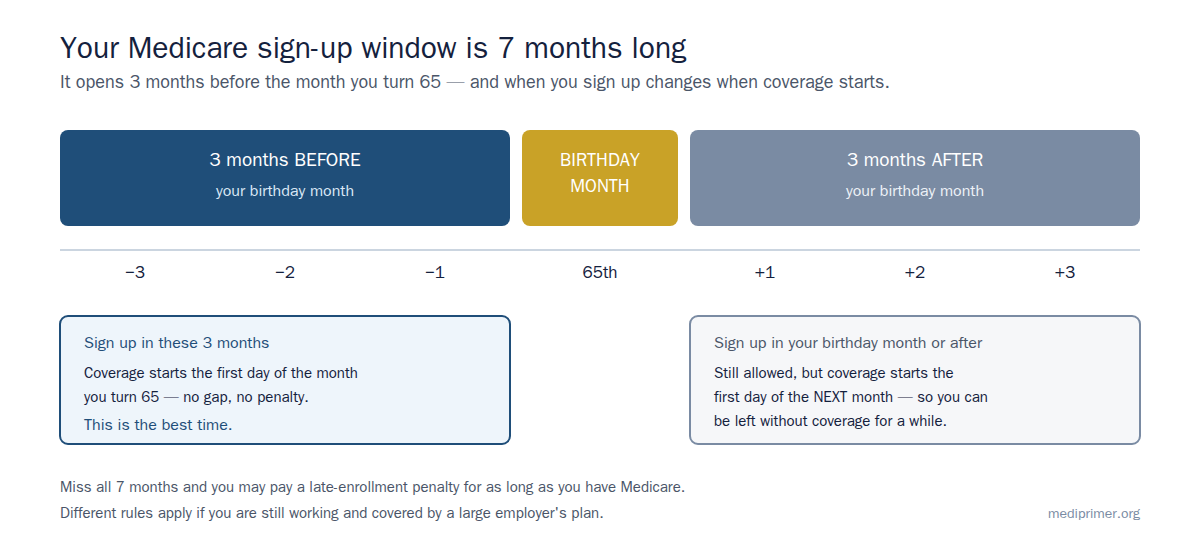
Turning 65? Here is the short answer. Your Medicare sign-up window is 7 months long. It starts 3 months before the month you turn 65 and ends 3 months after. Sign up in the first 3 months and your coverage starts the month you turn 65. Wait longer and coverage starts later. Missing the window can mean lasting late penalties and a gap in coverage. Use the navigator below for steps that fit your situation, or read the full walkthrough.
Turning 65 at a glance
- Know that Medicare is yours alone. There is no family Medicare. Your spouse has their own timeline.
- Mark your 7-month window on a calendar. Use the sign-up date calculator if you are not sure of your dates.
- Make free accounts at ssa.gov and medicare.gov.
- Check your situation. Are you still working? Do you have job coverage? Do you get Social Security? The answers change what you should do.
- Gather what you need before you sign up (see Step 4 below).
- Decide on purpose. If you delay any part, do it deliberately and inside your window. Free help is available from your state SHIP counselor.
Not sure of your exact dates? Use the sign-up date calculator — enter your birthday and it works out your window, when coverage starts, and what waiting would cost.
Not 65 yet? What to do in your early 60s
Nothing about Medicare requires action before your enrollment window opens. But if you're 61, 62, or 63 and want to get ahead of it, a little groundwork now makes the real deadlines easy — especially if retiring early is on the table.
- Learn the shape of it, without pressure. Read this walkthrough once now. You don't need to remember details — just the big ideas: Medicare is individual, the sign-up window is around your 65th birthday, and a few choices are hard to undo.
- Know your window before you pick a retirement date. If you stop work before 65, you'll need bridge coverage until Medicare starts — see Retiring or Losing Coverage and price it before you commit to a date.
- Married or partnered? Work both timelines together — Planning for Two covers the gap years when one of you is on Medicare and the other isn't.
- Watch your income timing. Your first Medicare premiums are set by your income from two years earlier. Big income events at 63 (a home sale, a large retirement withdrawal) can raise your premiums at 65. See Understanding Your Costs.
- If you use an HSA, plan its endgame. New HSA contributions must stop when Medicare Part A begins — and many people trigger Part A automatically by taking Social Security. See Working Past 65.
- Create your ssa.gov account now. You'll use it to check your work history (which decides whether Part A is free) and later to sign up.
Then set one reminder for the month you turn 64 to come back here. That's genuinely all the head start you need.
The full walkthrough, step by step
Prefer to read it all, or want the detail behind the navigator? Here's the complete walkthrough.
Step 1 — The one thing to understand first
Medicare is individual, not a family plan. Unlike the employer or Marketplace coverage you may be used to, there is no "family Medicare." You get your own Medicare based on your own age and work history. Your spouse gets theirs, on their own timeline. So if you're turning 65 but your spouse is younger — or is on their own insurance — you each make separate decisions. Keep that in mind the whole way through: this page is about your coverage; your spouse works through the same steps on their own clock. Married or partnered? Planning for Two walks through what a couple pays and how to handle two different timelines. On a Marketplace plan now? See Turning 65 on a Marketplace plan for when your savings stop and how to end the plan without a gap.
The other foundational idea: "Medicare" is really a few separate pieces (Parts A, B, D, and the private options that package them). You don't have to master them yet — just know that the decisions below are about which pieces you take and how.
Step 2 — Your timeline (this is the part with deadlines)
The single most important date is your Initial Enrollment Period (IEP): a 7-month window that starts 3 months before the month you turn 65, includes your birthday month, and ends 3 months after. This is when you can sign up without hassle. Missing it can cause permanent late penalties and a gap in coverage — so even if you decide to delay some parts (a valid choice in certain situations), you need to make that decision on purpose, within the window.
Step 3 — Which situation are you in?
Your best path depends on what coverage you (and your household) already have. Find yourself below and follow the link — each guide picks up exactly where your situation matters. You may match more than one.
I have VA health care
VA and Medicare are separate systems. There are real traps (especially around Part B) — this is likely your key page.
I (or my spouse) still work with employer coverage
You may be able to delay Part B without penalty — but only if the coverage qualifies. Employer size matters.
I'm retiring or losing job-based coverage
Losing coverage opens special windows — and COBRA has a costly Part B trap to avoid.
Money is tight
Programs can pay your premiums and lower drug costs. Many people qualify and don't realize it.
None of these — I'm just turning 65
The straightforward roadmap: your options, side by side, with a timeline.
Step 4 — Information to have ready
Before you sign up or talk to a counselor, gather these. Having them in one place makes every later step faster and prevents mistakes.
- Your Social Security number and, if you have one, your Medicare number.
- Your work history — roughly how long you (or a spouse) paid Medicare taxes (this decides whether Part A is free). Short U.S. work history? See Medicare for Immigrants and Green Card Holders.
- Details of any coverage you have now: employer/retiree plan, COBRA, VA health care, TRICARE, or a spouse's plan. If it's an active employer group plan (yours or a spouse's), ask HR whether it's based on current employment at a large employer — that's the only thing that lets you safely delay Part B. Separately, ask whether it's "creditable" drug coverage, which is what lets you safely delay Part D. VA health care and COBRA are never "current employment" coverage, so neither protects you from the Part B late-enrollment penalty, even though VA drug coverage often does count as creditable for Part D.
- A list of your doctors and whether keeping them matters to you.
- A list of your prescription drugs and your pharmacy (this drives your drug-coverage choice).
- Your spouse's coverage details and age (because they're on their own Medicare timeline).
- If money is tight: recent income and household size (for help-paying programs).
Step 5 — The decisions you'll actually make
Boiled down, Medicare comes to a short list of decisions. Here they are in plain terms. (None of this is advice — it's what to weigh. A free SHIP counselor can walk through your specifics with you.)
- Take Part A? Almost always yes. Part A (hospital) is premium-free for most people who worked enough, so there's usually no downside. (One exception: if you contribute to a Health Savings Account, enrolling in Part A stops new HSA contributions — see Working Past 65.)
- Take Part B now, or delay? This is the big one. Part B (doctors/outpatient) has a monthly premium. You can delay it without penalty only if you have other creditable coverage — generally active employer coverage from a large employer. Retiree plans, COBRA, and VA health care do not let you delay Part B safely. Delay without qualifying coverage and you face a lifelong penalty and a coverage gap.
- Original Medicare or Medicare Advantage? Two ways to get your benefits: Original Medicare (often paired with a Medigap supplement and a Part D drug plan) versus an all-in-one Medicare Advantage plan. Neither is "better" — it depends on whether you value provider freedom and predictability (Original + Medigap) or bundled extras and a spending cap (Advantage).
- How will you cover prescriptions? Through a Part D plan, built into a Medicare Advantage plan, or — for veterans — possibly through VA pharmacy. Missing drug coverage without a creditable alternative also carries a permanent penalty.
- Do you want a Medigap supplement? If you choose Original Medicare, your 6-month Medigap window (starting when you're 65 and enrolled in Part B) is the one time you can buy any supplement without medical underwriting. It's easy to miss and hard to get back.
- What about your spouse? They repeat these same decisions on their own timeline. If your spouse has private insurance now — through their own job, your former job, or the Marketplace — that coverage is separate from your Medicare, and separate from your VA care. When each of you nears 65 (or loses that coverage), each of you runs through these steps. See Working Past 65 and Retiring or Losing Coverage.
Step 6 — Your next actions
- Put your 7-month window on the calendar and set a reminder 3 months before your birthday month.
- Create your accounts at ssa.gov and medicare.gov.
- Confirm your coverage against both tests — for an active employer group plan, ask HR whether it's based on current employment at a large employer (this alone governs delaying Part B). Separately, ask your plan or the VA whether your drug coverage is "creditable" (this governs delaying Part D). Remember: VA health care and COBRA never satisfy the Part B test, no matter what their drug coverage counts as for Part D.
- Gather the Step 4 list for both you and your spouse.
- Call your free SHIP counselor to review your specific situation before you enroll — find yours here or call 1-800-MEDICARE (1-800-633-4227). SHIP is free, unbiased, and doesn't sell anything.
- Read the one or two situation pages that match you from Step 3, then enroll (or make a deliberate, documented decision to delay) before your window closes.