Enrolling in Medicare, in one sentence: some people get Medicare Part A and Part B automatically, but most must sign up themselves during a specific window, and missing that window can leave you without coverage and add a permanent penalty to your premium. This page covers Medicare enrollment; if you're looking for Medicaid instead, Medicaid has no annual enrollment window — you can apply for Medicaid insurance coverage any time through your state Medicaid agency, and Medicaid: Starting Out walks through that process.
To see your own dates rather than the general rules, try the Medicare sign-up date calculator.
Why Enrollment Timing Matters
Medicare has strict enrollment windows; Medicaid does not. That's the single biggest difference between signing up for the two programs, and it's worth knowing before you go further:
- Medicare: you can only sign up during certain windows. Outside those windows, you can't sign up, even if you need coverage now. Miss your first window and you might have a gap in coverage, plus a permanent penalty added to your premium for life.
- Medicaid: there's no enrollment period to miss. You can apply for Medicaid at any time of year, and coverage can start as soon as you're found eligible. See Medicaid Eligibility to check whether you qualify.
- Big life events (getting married, losing a job, having a baby, moving) can open special Medicare signup windows just for you, even outside the usual dates.
The rest of this page walks through Medicare's enrollment windows in detail. The first step is figuring out which one applies to you.
Do You Even Need to Sign Up? Some People Are Enrolled Automatically
Before you worry about windows and deadlines, check whether Medicare will enroll you on its own. You get Part A and Part B automatically — no application needed — if:
- You're already getting Social Security or Railroad Retirement benefits at least 4 months before you turn 65. Your Medicare card comes in the mail, and coverage starts the month you turn 65.
- You've received disability benefits for 24 months. Medicare starts automatically in your 25th month of benefits, at any age.
Two things to watch even if you're enrolled automatically. First, you can turn down Part B (for example, if you have coverage through a job) — but read Working Past 65 before you do, because dropping it wrongly triggers the lifelong penalty below. Second, if you live in Puerto Rico, only Part A is automatic: you must sign up for Part B yourself during your Initial Enrollment Period or you'll pay that penalty.
If neither bullet describes you — you're turning 65 and not yet taking Social Security — nothing happens automatically. You must sign up yourself during one of the windows below.
Medicare Enrollment Periods
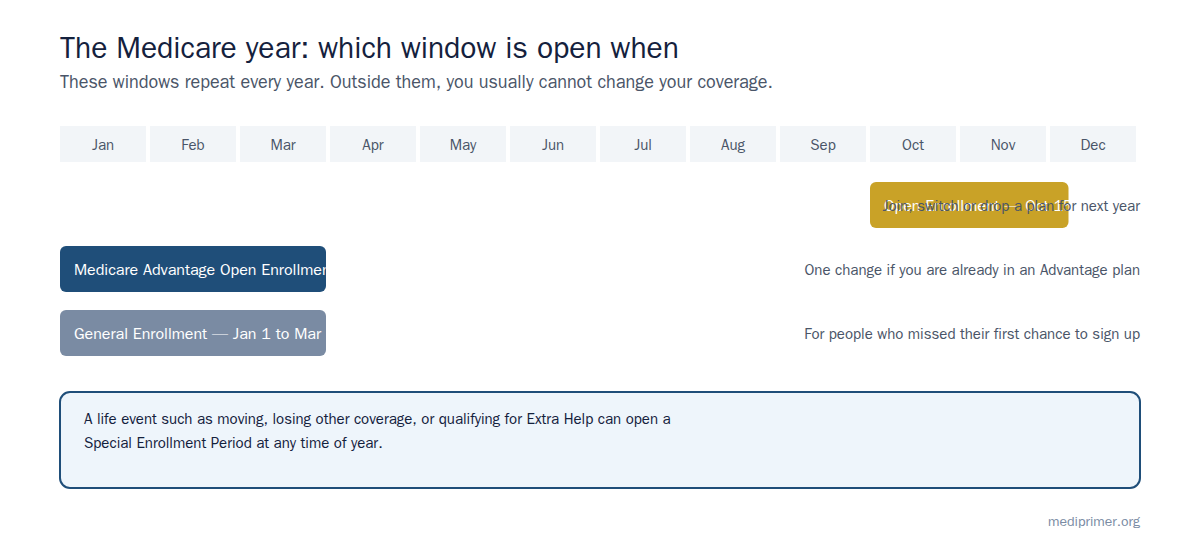
If you're turning 65 or becoming eligible for Medicare, you have several enrollment windows. Which one applies to you depends on your situation. These periods are set by federal law and are the same across the country.
| Period | Timing | What You Can Do |
|---|---|---|
| Initial Enrollment Period (IEP) | 7 months: 3 months before the month you turn 65, the month you turn 65, and 3 months after | Enroll in Part A (hospital insurance) and/or Part B (doctor and hospital care) for the first time. Sign up for Part D (prescription drugs) now to avoid a late penalty later. If you want a Medigap plan, buy it in the six months after your Part B starts — after that window, insurers can charge more or turn you down. |
| General Enrollment Period (GEP) | January 1 – March 31 each year | Enroll in Part A or Part B if you missed your Initial Enrollment Period. Coverage starts the first of the month after you sign up — so a missed window can still mean months without coverage. Signing up for Part D now will trigger a late penalty. |
| Medicare Advantage & Part D Annual Enrollment Period (AEP) | October 15 – December 7 each year | Switch from Original Medicare to Medicare Advantage or between Medicare Advantage plans. Change or drop your Part D plan. Go back from Medicare Advantage to Original Medicare and sign up for Medigap or Part D. Before you decide, read the Annual Notice of Change (ANOC) your plan sends in September. For this year's window, see Medicare Open Enrollment 2027. |
| Medicare Advantage Open Enrollment Period (MA OEP) | January 1 – March 31 each year | If you're in a Medicare Advantage plan now, you can switch to a different Medicare Advantage plan or go back to Original Medicare. You get one change per year during this period. |
| Special Enrollment Periods (SEPs) | Varies by life event; typically 60 days before or after a qualifying event | Enroll or change coverage if you have a qualifying life event (see "Which Window Applies to You?" below). You can sign up outside the regular windows. |
When Your Coverage Actually Starts
Signing up and being covered are two different dates. For Medicare, the rule since 2023 is simple:
- Sign up in the 3 months before your birthday month: coverage starts the first day of your birthday month.
- Sign up in your birthday month or the 3 months after: coverage starts the first day of the next month.
- Sign up during the General Enrollment Period (January–March): coverage starts the first day of the month after you sign up.
The practical takeaway: signing up early in your window means no gap. Waiting until the end of your window can leave you a month or more without coverage, even though you technically made the deadline. (If your birthday is on the first of the month, your dates shift a month earlier — confirm yours with Social Security.)
Late Enrollment Penalties
If you don't sign up for Medicare Part B or Part D when you first can, you pay a permanent late enrollment penalty. This is not a one-time charge. It adds to your monthly premium for the rest of your life.
Part B Late Enrollment Penalty
If you're eligible for Part B but don't sign up during your Initial Enrollment Period, you'll pay a permanently higher Part B premium. The penalty is based on how many months you were eligible but didn't enroll. This penalty is added to your monthly bill for the rest of your life.
Important: You can avoid this penalty if you had other coverage (such as health insurance from an employer or a spouse's job) and sign up for Part B within 8 months of losing that coverage. The exact dollar amounts change every year; see Medicare.gov for current figures.
Part D Late Enrollment Penalty
If you don't sign up for Part D (prescription drugs) or a Medicare Advantage plan with drug coverage when you first can, you'll pay a permanent late enrollment penalty on your Part D premium. Like the Part B penalty, it's based on how many months you didn't have coverage. This penalty stays with you as long as you have Part D.
You can avoid this penalty if you had other drug coverage (such as through an employer or union) and sign up for Part D within 63 days of losing that coverage. For current penalty amounts, visit Medicare.gov.
Full guide with worked examples and the steps to appeal a Part D penalty: Medicare Late Enrollment Penalties.
Marketplace (ACA) Coverage
If you're under 65 and not eligible for Medicare, or you're a non-citizen who doesn't qualify for Medicare, you can buy coverage through the Health Insurance Marketplace (also called the ACA Marketplace or Healthcare.gov).
Open Enrollment Period
The Marketplace Open Enrollment Period usually runs from November through January each year. During this time, you can sign up for a health plan, switch plans, or drop coverage. The exact dates change each year; check Healthcare.gov for this year's dates.
Special Enrollment Periods
If something major happens in your life — like losing job-based coverage, getting married, having a baby, moving to a new state, or changes to your Medicaid eligibility — you may be able to sign up outside the regular Open Enrollment Period. You usually have 60 days from the event to enroll. Different events have different rules, so visit Healthcare.gov to check if your event qualifies.
Premium Tax Credits & Cost Sharing Reductions
Based on your income, you might qualify for a premium tax credit (lowers your monthly premium) or cost sharing reductions (lower your copays, coinsurance, and deductibles). You must enroll through the Marketplace to get these credits. Your eligibility is figured out when you sign up, but it can change if your income or household size changes. Tell Healthcare.gov about any changes so your credits stay correct.
Medicaid & CHIP
Medicaid (a program for low-income people run by states and the federal government) and CHIP (Children's Health Insurance Program) don't have an annual enrollment period. You can apply any time and be approved any time, as long as you meet your state's rules.
Eligibility & Application
Medicaid and CHIP rules are different in each state. Both programs look at income, family size, age, disability, and other things. To apply, contact your state Medicaid office or apply through Healthcare.gov. Some states have simple online forms; others want you to come in person. You can apply whenever you want.
Renewals & Redeterminations
Once you're enrolled in Medicaid or CHIP, your eligibility gets reviewed regularly (usually once a year, but it varies by state). This is called a renewal or redetermination. You'll get a notice asking you to confirm your information (income, household size, address, etc.). You must respond by the deadline, even if nothing changed. If you don't respond, your coverage could end.
Keep your contact information up to date: If your address or phone number changes, tell your state Medicaid office right away. Not getting a renewal notice because mail wasn't forwarded is one of the biggest reasons people lose Medicaid coverage.
Which Window Applies to You?
Use this list to figure out which enrollment periods might apply to you. This is not personalized advice. You should check your specific deadlines with the program itself.
- Turning 65 or becoming eligible for Medicare: Use your Initial Enrollment Period. Sign up at least 3 months before you turn 65 to avoid gaps.
- Already on Medicare and want to change plans: Use the Medicare Advantage & Part D Annual Enrollment Period (Oct 15–Dec 7) to switch anytime, or the MA Open Enrollment Period (Jan 1–Mar 31) if you're in Medicare Advantage now.
- Lost job-based health coverage: You probably qualify for a Special Enrollment Period with Medicare, Marketplace, Medicaid, or CHIP, depending on your age. Call the program for your deadline.
- Having a baby or getting married: These count as qualifying life events for Marketplace and Medicaid/CHIP. You usually have 60 days to sign up.
- Moving to a new state: Changing states can open a Special Enrollment Period for Marketplace, Medicare Advantage, or Medicaid/CHIP, depending on your age and plan.
- Low income, have kids, or are a child: You might qualify for Medicaid or CHIP. You can apply anytime. Call your state Medicaid office or Healthcare.gov.
- Under 65 and need coverage now: If it's outside Marketplace Open Enrollment and you don't have a qualifying life event, you might need to look at Medicaid/CHIP (no deadline) or wait for the next Open Enrollment Period.
- On Medicaid or CHIP and got a renewal notice: Respond by the deadline right away. Don't ignore it, or your coverage will end.
Key Takeaways
- Sign up during your eligibility window. Missing it can mean no coverage and permanent penalties.
- Life events can open special signup windows outside the normal times.
- Late enrollment penalties for Medicare Part B and Part D are permanent and add to every month's bill.
- Marketplace (ACA) coverage has an annual Open Enrollment Period and Special Enrollment Periods for life events.
- Medicaid and CHIP take applications year-round, but you must respond to renewal notices on time.
- Always check your specific deadlines with the program itself.