Here's the short answer. Dual eligible means you qualify for both Medicare and Medicaid, and the two programs work together to pay your healthcare costs. What you actually get depends on your category — full-benefit, partial-benefit, or a Medicare Savings Program — which your income and state rules decide.
Medicaid eligibility on its own is based on income, and each state sets its own limits — that's true whether or not you also have Medicare. This page focuses on the dual-eligible combination; for the general Medicaid eligibility rules across all groups (children, pregnant people, parents, expansion adults, seniors, and people with disabilities), see Medicaid Eligibility, Waivers & Long-Term Care.
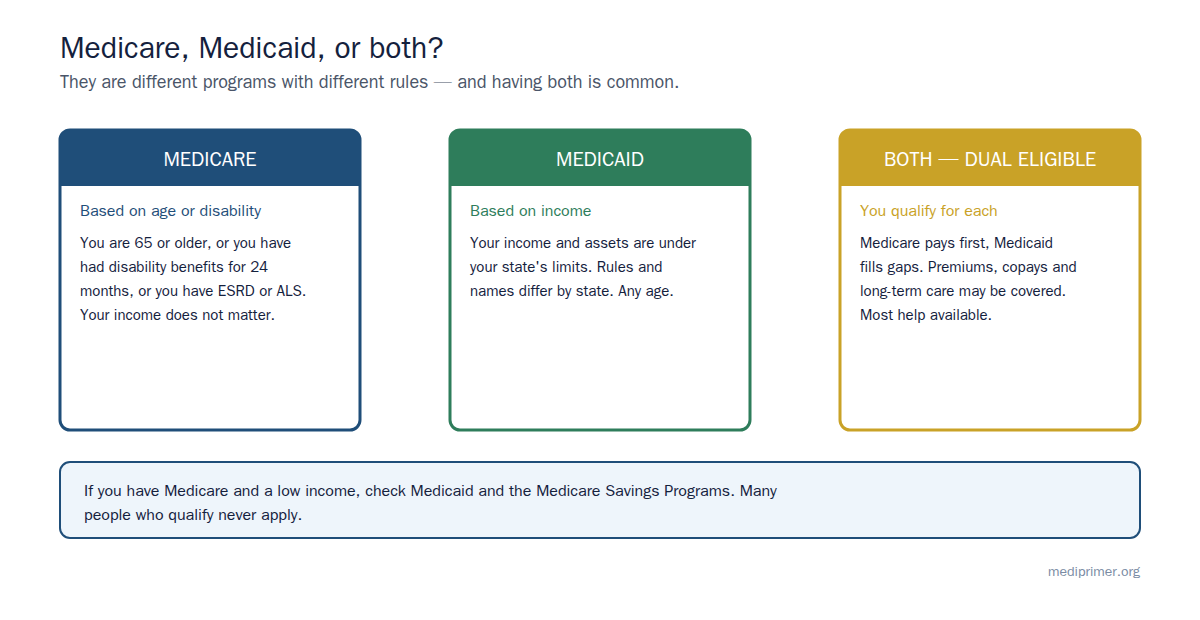
What Does It Mean to Be Dual Eligible?
Dual eligible means you qualify for both Medicare and Medicaid at the same time.
Medicare is a federal program for people 65 and older. It also covers some younger people with disabilities and people with end-stage renal disease (kidney failure).
Medicaid is a state and federal program for people with low income.
When you have both programs, they work together. They pay for your medical care, prescription drugs, and long-term care (like nursing homes). This coordination gives you coverage that neither program alone could provide.
Dual eligible status does not happen automatically. You must qualify for each program separately. Medicare looks at your age and disability status. Medicaid looks at your income and other factors that vary by state. When you meet the requirements for both programs, you are considered "dual" and can use both programs together.
The Two Types of Dual Eligible Status
Dual eligible people do not all have the same coverage.
Your coverage depends on your income and your state's rules. Understanding your category helps you know what services you can get and what financial help is available to you.
| Category | Who Is Eligible | What It Covers (Overview) |
|---|---|---|
| Full-Benefit Dual Eligible | Meets Medicaid's full income and resource limits for your state | All Medicare services; Medicaid covers remaining cost-sharing, premiums, and additional services like long-term care and dental (varies by state) |
| Partial-Benefit Dual Eligible | Income or resources slightly above Medicaid's full limits; qualifies for a Medicare Savings Program (MSP) | Medicare coverage; MSP pays some or all of Medicare premiums and cost-sharing; may have limited Medicaid benefits |
| Qualified Medicare Beneficiary (QMB) | Income below a threshold set annually; qualifies for the QMB program | MSP pays all of your Part A and Part B premiums and cost-sharing (copayments, coinsurance). Providers are protected from billing you; balance billing is prohibited. |
| Specified Low-Income Medicare Beneficiary (SLMB) | Income between QMB and SLMB limits (set annually by CMS) | MSP pays your Part B premium only; you are responsible for other Medicare cost-sharing |
| Qualifying Individual (QI) | Income between SLMB and QI limits (set annually by CMS) | MSP pays some or all of your Part B premium; you are responsible for other Medicare cost-sharing |
How Medicare and Medicaid Work Together
When you are dual eligible, the two programs work together to pay your medical bills. Here is the basic order:
- Medicare pays first. Medicare is the primary payer. It pays its share of covered medical services based on its rules.
- Medicaid pays second. After Medicare processes the claim, Medicaid may pay what Medicare did not cover. This includes premiums (monthly costs), copayments (fixed fees), coinsurance (your percentage of the bill), and deductibles (yearly amounts before coverage starts). Medicaid may also cover services Medicare does not cover at all, such as long-term care, dental care, vision care, and hearing aids. These extra services vary by state.
- You may pay nothing. If you are a QMB (Qualified Medicare Beneficiary), Medicaid protects you from most Medicare bills. Providers cannot bill you for cost-sharing (your share of costs). Providers who try to bill you anyway can be reported.
Medicare Savings Programs (MSPs): The Bridge
If your income is slightly above your state's full Medicaid limit, you may qualify for a Medicare Savings Program (MSP).
MSPs are part of Medicaid. They help pay some or all of your Medicare costs. There are three types:
- Qualified Medicare Beneficiary (QMB) — Pays all of your Part A and Part B premiums and all cost-sharing. This offers the strongest protection against extra bills.
- Specified Low-Income Medicare Beneficiary (SLMB) — Pays your Part B premium only.
- Qualifying Individual (QI) — Pays part or all of your Part B premium.
The amounts these programs pay change each year. The Centers for Medicare & Medicaid Services (CMS) sets the income limits each year and publishes them on CMS.gov. Income and resource limits are different in each state. Contact your state Medicaid agency to see if you qualify.
Dual Eligible Special Needs Plans (D-SNPs)
If you are a full-benefit dual eligible person, you can enroll in a Dual Eligible Special Needs Plan (D-SNP).
A D-SNP is a type of Medicare Advantage plan. It is designed for people who have both Medicare and Medicaid.
D-SNPs combine your Medicare and Medicaid benefits into one plan. This can make it easier to manage your care. These plans often include extra benefits, such as dental, vision, hearing, and fitness programs. Some load extras onto a prepaid "flex card." Our guide to Medicare flex cards explains what the cards really do and how to read the ads.
However, D-SNPs are different from each other. They have different benefits, different doctors and hospitals in their networks, and different rules for getting approval before treatment. If you think about choosing a D-SNP, compare your options carefully. Make sure your doctors and hospitals are in the network. Learn more at Medicare Advantage and Plan Types. Full guide: Medicare Special Needs Plans: D-SNP, C-SNP, and I-SNP explained, including integrated D-SNPs and the once-a-month enrollment window for people with Medicaid.
PACE: One Team for Medicare and Medicaid Care
Some dual eligible people who need nursing-home-level care can join PACE, the Program of All-Inclusive Care for the Elderly. PACE combines Medicare and Medicaid benefits in one program, so many members can stay in the community instead of a nursing home. Full guide: PACE: a nursing home alternative.
Balance-Billing Protection for QMB Enrollees
QMB (Qualified Medicare Beneficiary) status offers one of the strongest protections for dual eligible people. It protects you from extra billing.
If you have QMB status, Medicaid pays what Medicare did not pay. Providers are not allowed by law to bill you for the remaining costs.
This protection is important. It means a healthcare provider cannot charge you extra just because you have Medicare. If a provider tries to bill you for costs that QMB should have covered, you can report it to your state Medicaid agency or to CMS. This strong protection is a key reason QMB status is so valuable.
Extra Help with Prescription Drug Costs
If you are dual eligible, you may automatically qualify for Extra Help (also called the Low-Income Subsidy or LIS).
Extra Help reduces what you pay out-of-pocket for Medicare Part D prescription drugs. It helps pay your premiums (monthly costs), deductibles (yearly amounts), and cost-sharing.
Many dual eligible people get Extra Help without having to apply. The Social Security Administration shares information with CMS. However, you should check your status. You can log in at ssa.gov or call Social Security at 1-800-772-1213. Your Extra Help amount changes each year based on your income. Full guide: Extra Help for Medicare drug costs.
Eligibility and Variation by State
Medicaid rules are different in each state.
This means your dual eligible status and your benefits are not the same as other states. One state may cover dental or hearing aids. Another state may not. Income limits for Medicaid eligibility change from state to state. The limits for Medicare Savings Programs also change by state.
To understand what you qualify for, you need to know your state's rules. Visit our State Directory to find your state Medicaid agency's phone number and address. Or go directly to medicaid.gov to find your state's office. You can also call your local State Health Insurance Assistance Program (SHIP). SHIP provides free help with Medicare and Medicaid questions.
Getting Help Understanding Your Dual Status
Being dual eligible can be complex. You have two programs to manage, and rules are different in each state.
If you need help, free resources are available. You can ask:
- Your state SHIP program for free, private counseling.
- Your state Medicaid agency to explain what you qualify for and what benefits you get.
- Medicare.gov for information about all Medicare programs.
- Medicaid-managed long-term care plans in your state. They can explain how medical care, mental health, and long-term care benefits work together.
Key Takeaways
- Dual eligible means you have both Medicare and Medicaid working together to pay for your care.
- Your type of dual status affects what you pay and what is covered. Types include full-benefit, partial-benefit, or one of three Medicare Savings Programs.
- Medicare pays first. Then Medicaid pays for remaining costs and services Medicare does not cover.
- Qualified Medicare Beneficiaries (QMB) get strong protection against extra bills.
- D-SNPs combine Medicare and Medicaid benefits for full-benefit dual eligible people.
- Most dual eligible people automatically get Extra Help paying for prescription drugs.
- Rules and benefits are different in each state. Check your status with your state Medicaid agency.