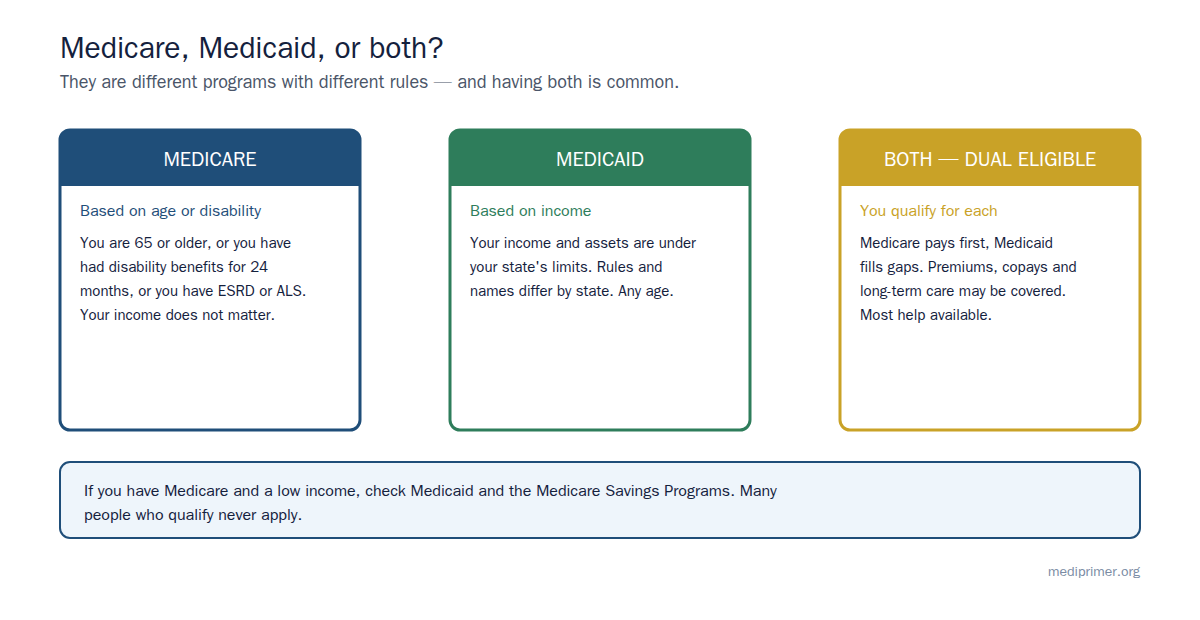
The short answer. Medicare (老年醫療保險, often called the "red-white-blue card" or 紅藍卡) is federal insurance for people 65 or older, or certain younger people with disabilities. It works the same way in every state. Medicaid (醫療補助, often called the "white card" or 白卡) is a joint federal-state program for people with low income. Each state runs its own Medicaid program, so rules differ from state to state. A person can qualify for one, the other, or — for many older adults with modest income — both at once. Qualifying for both is called dual eligible (雙重資格).
Medicare (老年醫療保險 / 紅藍卡): insurance you pay into
Medicare is run the same way nationwide by the federal Centers for Medicare & Medicaid Services. You qualify by age (65+) or disability — not by how much money you have. It is funded by payroll taxes you and your employer already paid over your working years, plus monthly premiums. Because it is insurance you paid into, it is not a means-tested benefit. See Medicare vs. Medicaid: The Key Differences for the full program-by-program breakdown, or Coverage Basics for how Medicare's parts (A, B, C, D) fit together.
Medicaid (醫療補助 / 白卡): help based on income
Medicaid is jointly funded and administered by the federal government and each state, which is why eligibility rules, income limits, and covered services are different depending on where you live. Medicaid mainly serves people with low income — children, pregnant women, people with disabilities, and low-income adults and seniors. You can apply for Medicaid at any time of year through your state's Medicaid agency; see Medicaid Eligibility, Waivers & Long-Term Care for pathways and how they vary by state, or the State Medicaid Directory to find your state's program.
When both apply: dual eligible (雙重資格)
Many older adults with modest retirement income qualify for both programs at once. When that happens, Medicare pays first and Medicaid pays second — covering premiums, deductibles, and copays that Medicare does not, and sometimes adding services Medicare does not cover at all, like long-term care. There are also smaller Medicare Savings Programs for people whose income is a little too high for full Medicaid but still qualifies for help with Medicare premiums. See the full Dual Eligible guide for how the two programs coordinate, and Getting Help Paying to check which programs you might qualify for.
Why the community nicknames confuse people
Chinese-speaking communities in the U.S. often use the physical card colors as shorthand: the mostly-white Medicaid card becomes 白卡 ("white card"), and the red-white-blue Medicare card becomes 紅藍卡 ("red-blue card"). Those nicknames are useful shorthand among family and friends, but they are not official program names, and using them interchangeably is a common source of confusion — especially the worry that either program could count against someone's immigration status. Medicare is insurance paid into through work; Medicaid rules around immigration status vary and are a legal question, not a coverage question. For a deeper look at why these nicknames don't map cleanly onto the official programs, see 白卡 and 紅藍卡: What Medicaid and Medicare Actually Mean.
Common questions
Is Medicare the same as Medicaid?
No. Medicare (老年醫療保險) is federal insurance for people 65 or older or with certain disabilities, the same in every state. Medicaid (醫療補助) is a joint federal-state program for people with low income, and its rules differ by state. See Medicare vs. Medicaid for the full comparison.
Can someone qualify for both Medicare and Medicaid?
Yes. Qualifying for both at once is called dual eligible (雙重資格). Medicare pays first and Medicaid helps with what Medicare does not cover, including premiums and cost-sharing for people with low income. See Dual Eligible for details.
Does Medicare count as a public benefit that affects immigration status?
Medicare is insurance people pay into through payroll taxes and premiums, not a means-tested benefit. Questions about how any program interacts with immigration status are legal questions — ask an immigration attorney or a Board of Immigration Appeals accredited representative, not this site.
Related MediPrimer guides
- Medicare vs. Medicaid: The Key Differences
- Dual Eligible: Having Both Medicare and Medicaid
- Medicaid Eligibility, Waivers & Long-Term Care
- 白卡 and 紅藍卡: What Medicaid and Medicare Actually Mean
- Health Insurance Terms in Chinese and English
Official sources
- Medicare.gov
- Medicaid.gov
- CMS.gov (Centers for Medicare & Medicaid Services)
- HealthCare.gov: Medicare (definition and basics)